日本語

Location & Access ↓ / Future Wakayama ↓ /
Cost ↓ / Message ↓

- Location & Access -

Wakayama Marina City

A New Aquarium at Wakayama Marina City

Wakayama Marina City is the proposed site for the aquarium.

Surrounded by the sea, this is where a journey through the waters of Japan begins in Wakayama.
Why choose this location?
Marina City has a large area of land that can be secured for development, making it possible to build a large-scale aquarium relatively quickly.
It is also an established tourist destination, which could help attract visitors from the early stages.
In addition, it is about 15 minutes by bus from Kainan Station, making it easier to spread the benefits of the aquarium project throughout Wakayama Prefecture.
How much land is available?
According to figures published by Wakayama Prefecture, the available land covers approximately 20 hectares.
For comparison, Okinawa Churaumi Aquarium occupies around 2 hectares, while Nagoya Port Aquarium, one of Japan’s largest aquariums, occupies around 4 hectares. This illustrates just how large the site is.
A site of this scale, already functioning as a tourist destination, offers exceptionally favorable conditions for a new aquarium.
Railway

Take the Train to the Aquarium!

From central Wakayama, Namba, and Kansai International Airport, all the way to the aquarium.

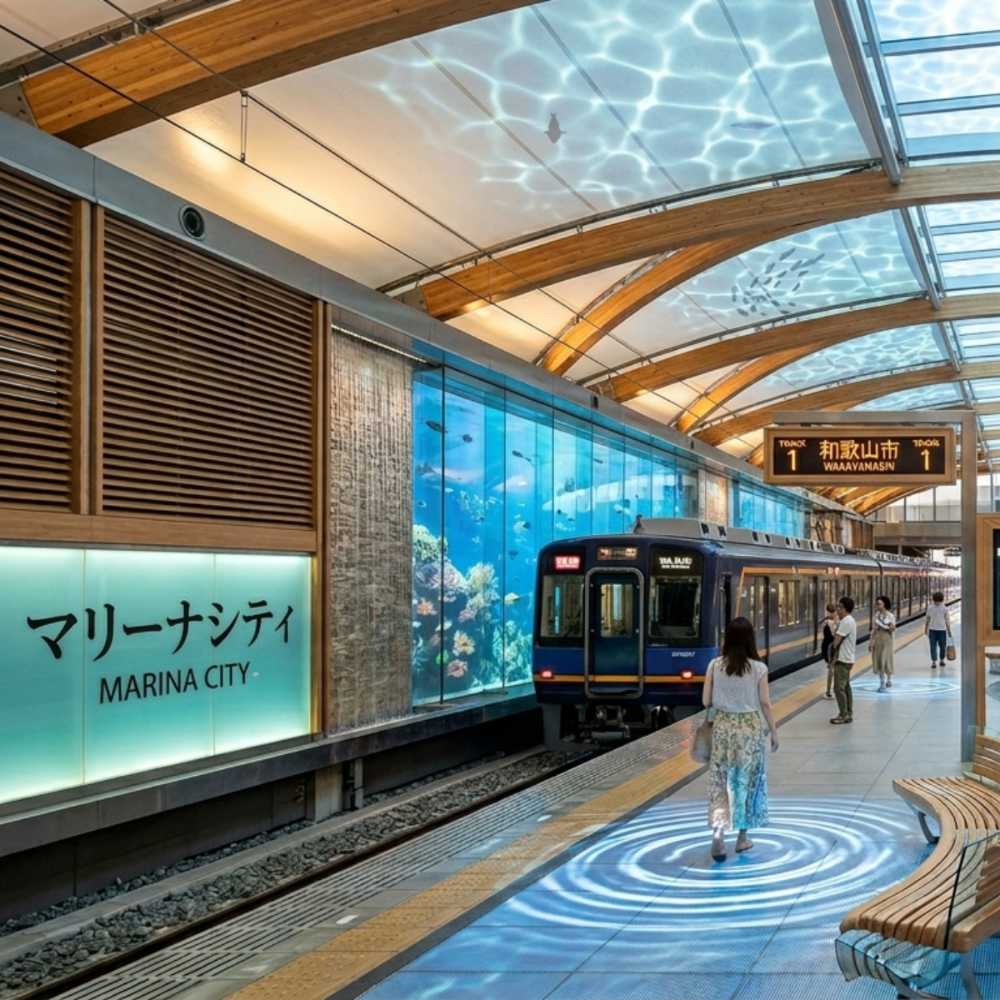
We also propose extending the Nankai Wakayamako Line to Wakayama Marina City!

Tell me more about the proposed railway extension.
The proposal is to extend the Nankai Wakayamako Line.
From Wakayamako Station, the line would continue south, with a proposed Wakaura Station near the current Shin-Wakaura intersection, then continue farther south to a proposed Marina City Station.
Proposed railway route map
If realized, the line would improve access not only to the aquarium, but also to Wakaura and Marina City.
Direct connections to Namba and Kansai International Airport could also make it a new gateway for tourism in Wakayama.

Other routes have been considered. However, taking into account densely populated residential areas, frequent traffic congestion during construction, and noise concerns, we believe this proposal is the most practical option.
Why not use buses or BRT?
At present, visitors to Marina City arrive at different times, so existing transport can accommodate them. An aquarium, however, would likely concentrate passenger demand in the morning and evening.
If annual attendance were 1 million visitors, an estimated 1,200–2,000 people per hour might need to be transported during peak periods.
This would require approximately 21–33 buses per hour, or 11–17 BRT vehicles per hour. Securing enough buses and drivers would be difficult, and the additional vehicles would also contribute to road congestion.
More importantly, visitors could end up packed into crowded buses, creating an uncomfortable experience on the way to the aquarium.
Even the introduction of autonomous buses would not resolve the capacity challenge if visitor numbers were high.
Monorail or light rail transit (LRT) construction would take place at ground level over an extended period, increasing disruption for local residents and traffic.
Would building a new railway line be feasible?
Because the line would run underground in the suburbs of Wakayama City, construction costs could be considerably lower than those for new railway lines in major urban areas.
Using a single-track design could also reduce station construction costs, potentially making this a comparatively low-cost railway project by recent standards.
In addition, much of the route would run through tunnels beneath roads or the seabed, helping minimize impacts on local residents and the need to acquire land.
Above all, a direct connection to Namba and Kansai International Airport could have a substantial impact on the local economy and inbound tourism.
Although Wakayama is a regional city, we believe an extension of the Nankai Wakayamako Line has a realistic chance of being achieved.
(For estimated costs, please see the “Costs” section near the bottom of the page.)

- Future Wakayama -

Now, let's take a glimpse into Wakayama's future!
Click the icons on the map to explore different possibilities.

Can an aquarium really change a city?
Not by itself, of course.

This proposal was designed from the beginning as a regional revitalization project based on Wakayama's history and culture.
The aquarium is not the goal itself—it is simply the facility that best represents Wakayama's identity.
Unlike temporary trends or attractions that may disappear over time, this concept is rooted in Wakayama itself.
Combined with improved transportation and tourism infrastructure, it has the potential to transform the image of Wakayama for generations.
In reality, this website is not just about building an aquarium—it's about imagining a new future for Wakayama.

- Cost -

Approx. ¥17.5–22 Billion

Aquarium

Estimated cost including recent construction inflation and traditional Japanese design elements.

Approx. ¥87–160 Billion

Railway Extension

Estimated cost based on a single-track shield tunnel system.

- Message -

News about Wakayama often seems to focus on challenges and decline...

Isn't it time for something exciting?

And before you leave, there's one thing I'd like to ask.

"Wouldn't an aquarium like this make Wakayama a more exciting place?"